Looking for the best non-toxic air fryer in 2026? Start with the part that actually touches your food—not a health-sounding marketing label. This Kitchen Comfy comparison covers six air fryers with clearly described glass, ceramic-coated, stainless-steel-forward, or enamel cooking surfaces, and explains the material claims and everyday trade-offs for U.S. households.
Our approach is practical: compare the exact food-contact surface, check model-specific PFAS and PTFE disclosures, then weigh capacity, cleaning, durability, replacement parts, and kitchen space. A manufacturer’s PFAS-free claim about one surface should never be treated as a guarantee about every component of the appliance.
How this guide was researched (updated November 2026): We checked manufacturer model pages, product specifications, and regulatory guidance. These are editorial recommendations, not hands-on cooking tests, independent PFAS laboratory tests, or safety certifications. Material statements are attributed to manufacturers and should be rechecked before purchasing. For context on PFAS in food-contact materials, see the U.S. FDA’s explanation.
What Makes an Air Fryer PFAS-Free or PTFE-Free?
There is no single official industry definition of a “non-toxic air fryer.” For this guide, I use the term practically: an air fryer is more compelling for this category when its food-contact materials are clearly disclosed and, for shoppers trying to avoid fluorinated coatings, the manufacturer explicitly states that the relevant cooking surface is PFAS-free and/or PTFE-free.
That distinction matters because ceramic does not automatically mean PFAS-free, stainless steel on the outside does not guarantee a stainless-steel basket, and PFOA-free does not mean the same thing as PFAS-free.
If I wanted the shortest possible shortlist today, I would start with the Ninja Crispi for a glass cooking surface, the COSORI TurboBlaze for a conventional basket design, the COSORI Iconic for a premium stainless-steel-forward design, and the Midea Flexify Pro for an air-fryer toaster oven.
Best Non-Toxic Air Fryers of 2026: Our Top 6 Picks
| Pick | Best for | Why it stands out |
|---|---|---|
| Ninja Crispi | Glass cooking surface | Glass containers with an explicit PFAS-free cooking-surface claim |
| COSORI Iconic | Premium design | 304 stainless-steel basket plus PFAS-free ceramic-coated cooking surfaces |
| COSORI TurboBlaze | Everyday basket air fryer | PFAS-free ceramic-coated basket and crisper plate |
| Midea Flexify Pro | Air fryer toaster oven | PFAS-free enamel interior claim |
| bella EverGood 4QT Slim | Compact kitchens | EverGood ceramic coating made without PFAS and PTFE |
| Ninja Crispi Pro | Premium glass upgrade | Larger glass-system format for shoppers who like the Crispi concept |
These recommendations are not a claim that one appliance is “safe” while every other air fryer is unsafe. They are based on how clearly the manufacturer describes the relevant food-contact materials and how well each design fits a particular kitchen.
1. Ninja Crispi: Best Air Fryer With a Glass Cooking Surface
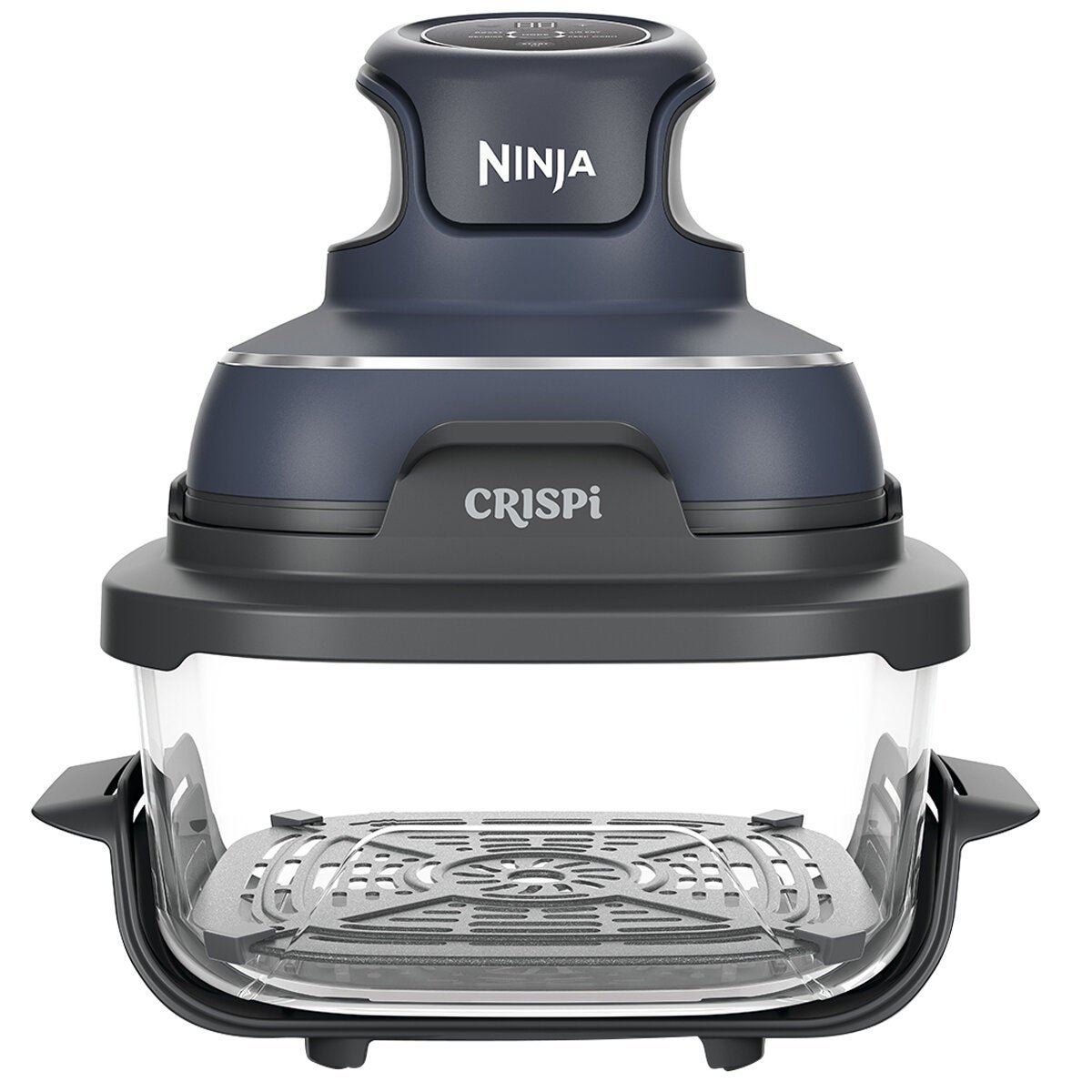
Product image: Costco Australia · Manufacturer specifications. Product claims reflect published manufacturer information, not independent lab testing.
If your main reason for shopping for a non-toxic air fryer is to avoid a conventional coated metal basket, the Ninja Crispi is one of the clearest designs to understand.
Ninja uses its CleanCrisp glass containers and states that the glass cooking surface is 100% PFAS-free. Ninja also describes the system as designed for cooking and storage without PFAS and PTFE. That is unusually useful information because it tells us what material is actually doing the cooking rather than simply calling the whole appliance non-toxic.
Why I picked it
The biggest advantage is material clarity. Instead of trying to work out whether a dark nonstick basket contains a particular coating, the primary cooking container is glass. For a shopper who wants to minimize uncertainty around fluorinated nonstick coatings, that makes the product easy to understand.
The glass containers can also move from cooking to serving and storage. The system includes a larger 4-quart container and a smaller 6-cup container, so it can work for both a quick snack and a larger meal.
What I like
- Glass cooking surface
- Explicit PFAS-free glass cooking-surface claim
- Explicit PFAS/PTFE avoidance positioning
- Useful cook-and-store concept
- Compact alternative to a large countertop oven
What I would consider before buying
Glass does not make the entire appliance “chemical-free.” The appliance still contains electrical components, plastics, seals, and other materials. My point is narrower: the food-contact cooking container is much easier to identify and evaluate.
I would also consider the cooking style. If you frequently cook very large batches, a compact glass system may not replace a larger family-size basket or toaster-oven-style air fryer.
Best for: shoppers who want a glass cooking surface and clear PFAS/PTFE positioning.
Kitchen Comfy verdict: This is my first place to look when the priority is a clearly identified glass cooking surface.
2. COSORI Iconic: Premium PFAS-Free Ceramic Air Fryer
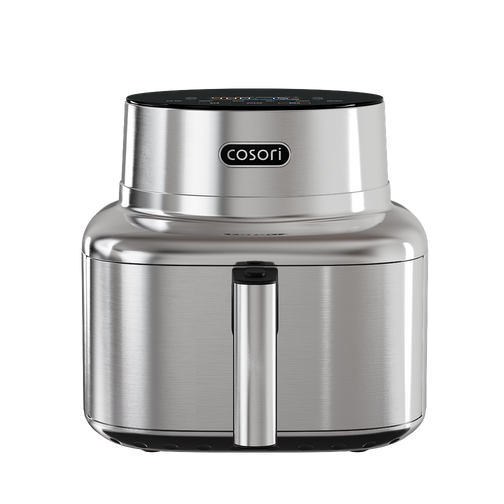
Product image: COSORI · Manufacturer specifications. Product claims reflect published manufacturer information, not independent lab testing.
The COSORI Iconic takes a different approach. It combines a stainless-steel-heavy construction with ceramic-coated cooking surfaces rather than relying on a bare stainless-steel cooking basket alone.
COSORI says its cooking surfaces are free of PFAS and BPA. The company identifies the basket as 304 stainless steel and the exterior structure as 430 stainless steel. That level of material detail is exactly what I want to see when evaluating a product for this guide.
Why it stands out
The 6.5-quart capacity is practical for family cooking, and the 90–450°F range gives it plenty of flexibility for everyday air frying. The design also feels more substantial than a basic compact basket appliance.
There is an important nuance here. Calling the Iconic a “stainless-steel air fryer” does not mean every food-contact surface is bare stainless steel. COSORI describes ceramic-coated cooking surfaces, so I would use the more precise description stainless-steel-forward construction with PFAS-free ceramic cooking surfaces.
What I like
- 6.5-quart capacity
- 304 stainless-steel basket
- 430 stainless-steel exterior structure
- PFAS-free ceramic-coated cooking surfaces according to COSORI
- 90–450°F temperature range
- Premium construction and long warranty positioning
What I would consider
If your goal is specifically a completely uncoated stainless-steel food-contact basket, this is not the same proposition as a bare stainless-steel cooking surface. Read the manufacturer’s current parts and material description carefully.
Best for: families wanting a premium basket air fryer with strong material disclosure.
Kitchen Comfy verdict: A strong choice when you want premium construction and PFAS-free ceramic cooking surfaces rather than a simple glass system.
3. COSORI TurboBlaze: Best Everyday PFAS-Free Basket Air Fryer
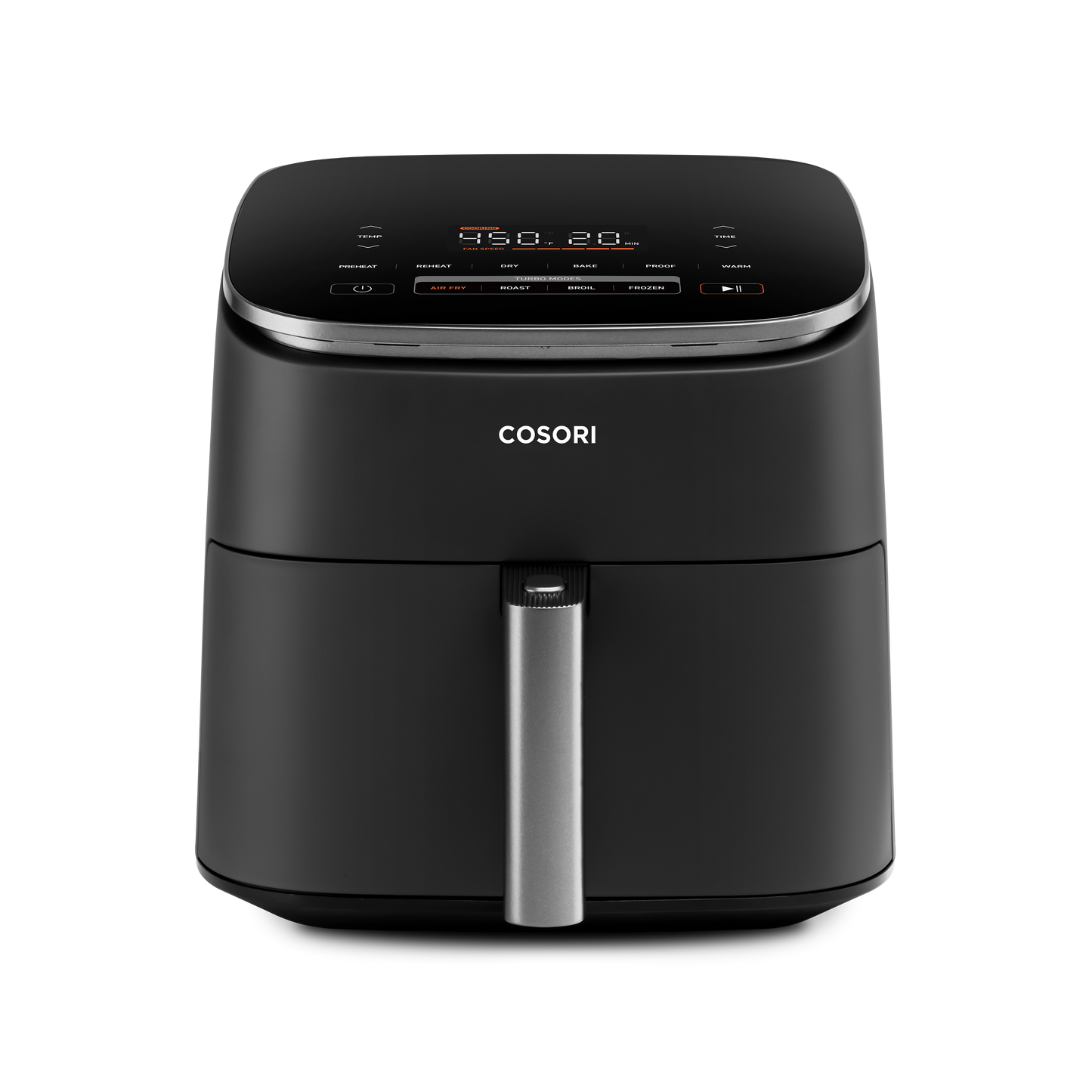
Product image: COSORI · Manufacturer specifications. Product claims reflect published manufacturer information, not independent lab testing.
If I were looking for a straightforward everyday basket air fryer, the COSORI TurboBlaze would be high on my list. Its main appeal for this guide is simple: COSORI explicitly describes the basket and crisper plate as PFAS-free ceramic-coated surfaces.
The 6-quart capacity also makes it more practical for everyday family meals than many tiny air fryers. It is the kind of format that works for vegetables, chicken, potatoes, reheating leftovers, and other common kitchen jobs without taking on the size of a full toaster oven.
Why I picked it
I like the combination of a familiar basket format and a specific coating disclosure. You do not have to infer that ceramic means PFAS-free; COSORI makes the PFAS-free claim for the relevant cooking surfaces.
What I like
- 6-quart capacity
- PFAS-free ceramic-coated basket
- PFAS-free ceramic-coated crisper plate
- 90–450°F temperature range
- Dishwasher-safe basket and crisper plate according to COSORI
- Familiar basket-air-fryer workflow
What I would consider
This is still a coated cooking surface. If you want to avoid coated surfaces altogether, the Ninja Crispi’s glass approach may better match your goal.
Also, “PFAS-free” should not be stretched into “nothing can ever migrate from the appliance.” A product claim is specific to the materials and testing or specifications behind it.
Best for: everyday family cooking when you want a conventional basket design with an explicit PFAS-free ceramic claim.
Kitchen Comfy verdict: One of the easiest recommendations for someone who wants a normal basket air fryer without giving up clear PFAS-free material information.
4. Midea Flexify Pro: Best Air Fryer Toaster Oven
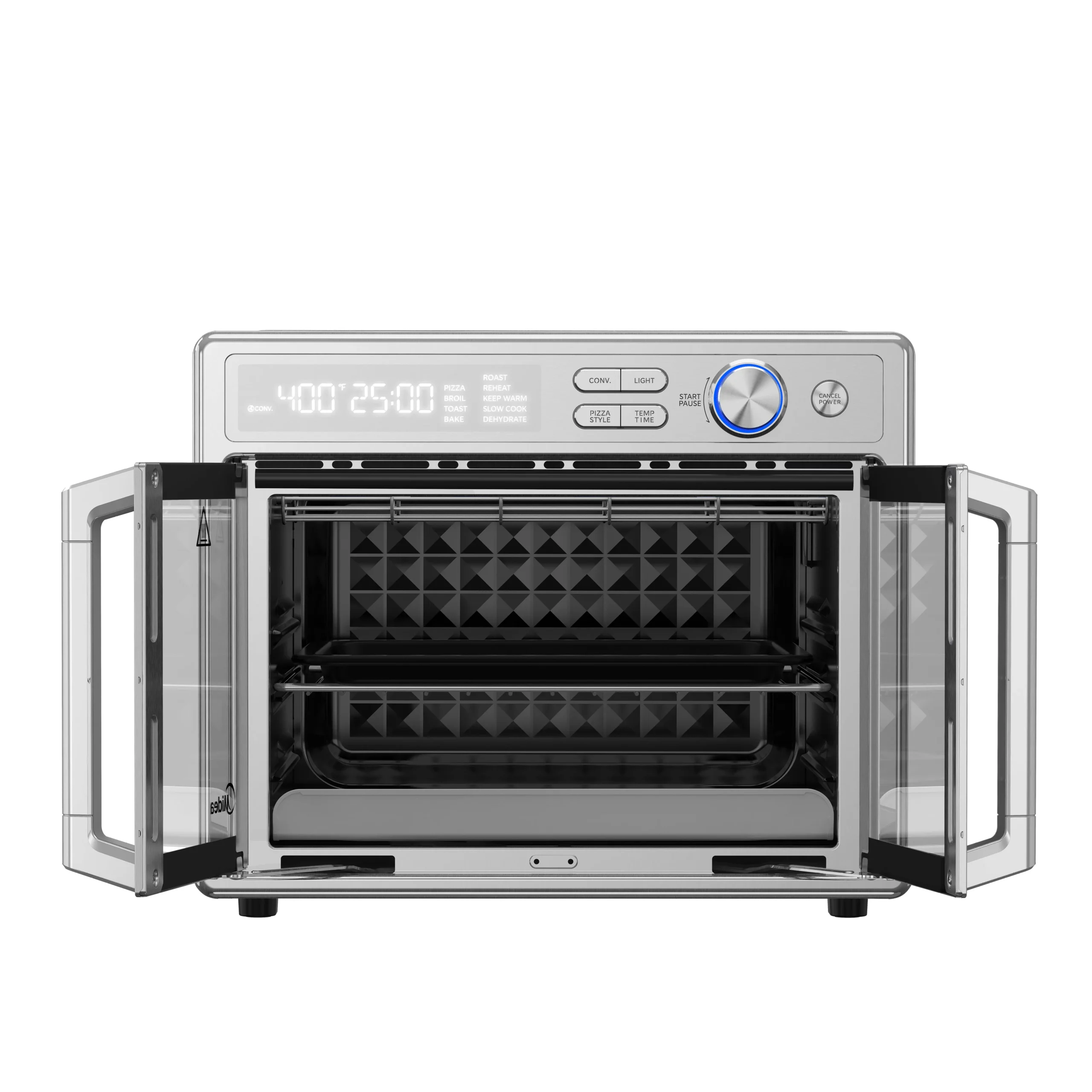
Product image: Midea · Manufacturer specifications. Product claims reflect published manufacturer information, not independent lab testing.
Not everyone wants a pull-out basket. If your goal is to replace several countertop appliances with one larger machine, an air-fryer toaster oven can make more sense.
The Midea Flexify Pro is particularly interesting because Midea identifies its interior as premium enamel and describes the interior coating as PFAS-free. That gives this model a different material profile from a conventional black nonstick basket.
Why I picked it
The 26.4-quart format is designed around multifunction cooking. Midea lists air frying, baking, roasting, toasting, and other cooking modes, along with dedicated pizza modes. For a family kitchen, that versatility can matter more than having the smallest possible footprint.
What I like
- Large 26.4-quart oven-style capacity
- PFAS-free enamel interior claim from Midea
- Multiple cooking functions
- Useful alternative to a separate toaster oven and air fryer
- French-door format
What I would consider
This is a much larger countertop appliance than a compact basket air fryer. Before buying, measure the counter depth, door clearance, ventilation space, and storage area for the accessories.
Also remember that the interior is only one part of the appliance. Accessories such as trays and racks should be checked against the manufacturer’s current material and care instructions.
Best for: families who want an air-fryer toaster oven and value a PFAS-free interior claim.
Kitchen Comfy verdict: A compelling oven-style option when multifunction cooking and a clearly disclosed PFAS-free interior are more important than compact size.
5. bella EverGood 4QT Slim: Best Compact Ceramic Air Fryer
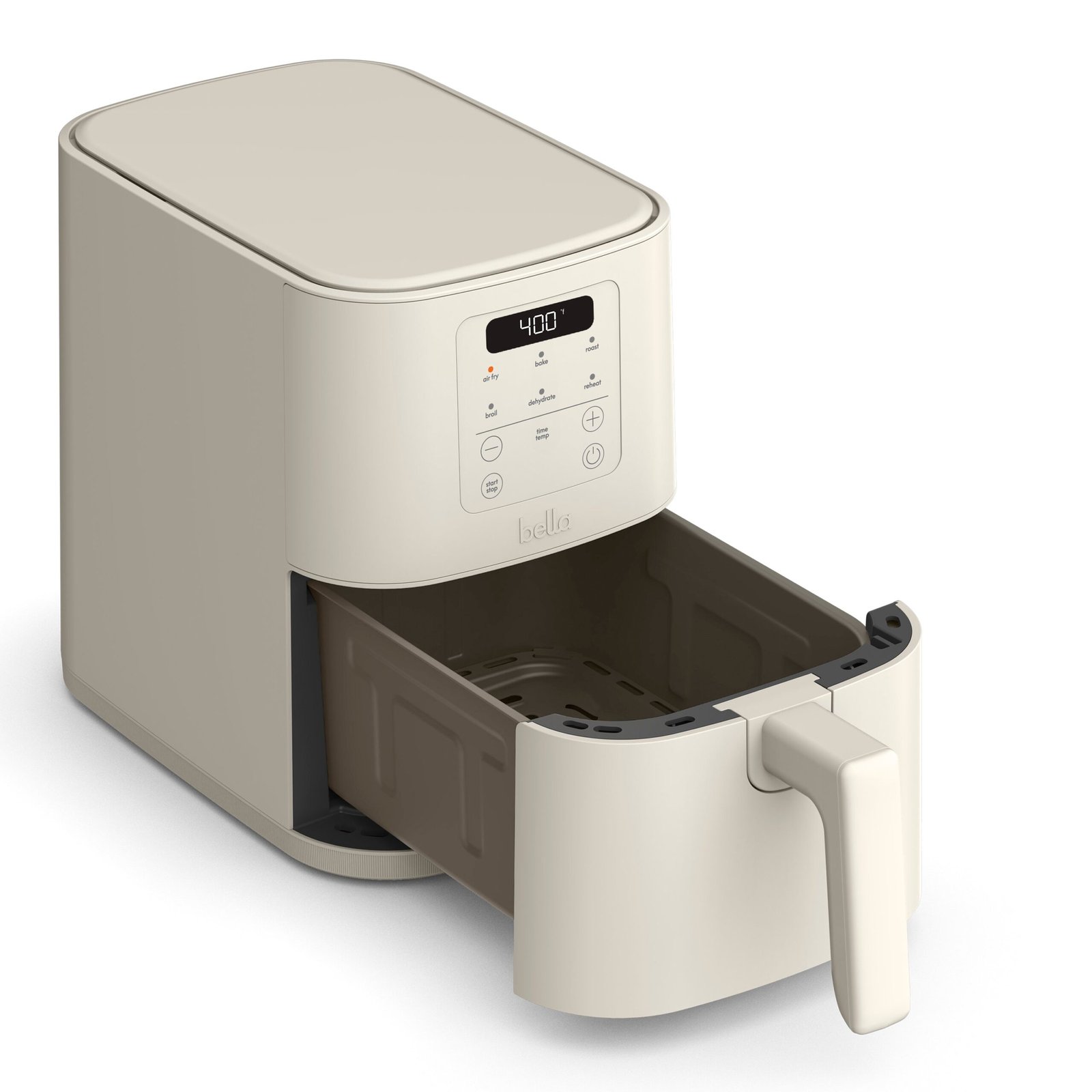
Product image: bella · Manufacturer specifications. Product claims reflect published manufacturer information, not independent lab testing.
A small kitchen changes the buying decision. A huge air fryer may have impressive specifications, but it is not useful if it takes over the counter.
The bella EverGood line is interesting because bella says its EverGood ceramic nonstick coating is made without PFAS, PFOA, PTFE, lead, and cadmium. That is a stronger material statement than simply saying “ceramic.”
Why I picked it
The compact 4-quart class is a sensible place to look for one or two people, smaller households, apartments, or anyone who cooks smaller portions. It also gives shoppers a lower-footprint option without abandoning the ceramic/PFAS-free approach.
What I like
- Compact size
- EverGood ceramic coating
- Manufacturer states the coating is made without PFAS and PTFE
- Also excludes PFOA, lead, and cadmium according to bella
- Useful for smaller kitchens
What I would consider
A 4-quart air fryer is not automatically the best choice for a large family. If you routinely cook several portions at once, the smaller basket may force multiple batches.
Best for: smaller households and kitchens where footprint matters.
Kitchen Comfy verdict: A good compact option when explicit coating information matters but you still want a familiar basket format.
6. Ninja Crispi Pro: Best Premium Glass Air Fryer
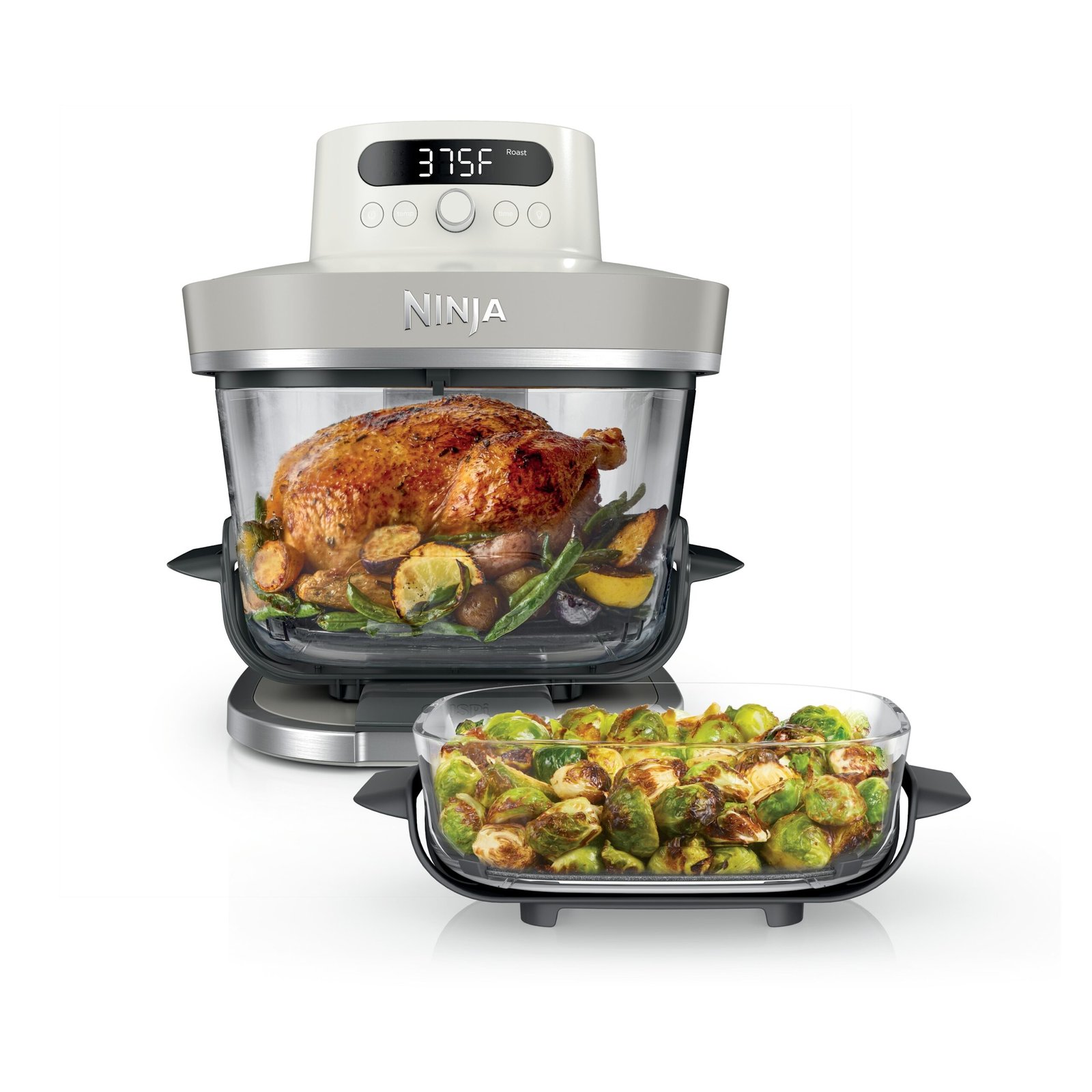
Product image: Bed Bath & Beyond · Manufacturer specifications. Product claims reflect published manufacturer information, not independent lab testing.
If you like the idea of a glass cooking system but want something larger and more flexible, the Ninja Crispi Pro deserves consideration. Recent independent coverage has highlighted its larger glass-container approach and higher-capacity format.
The reason I include it is not simply that it is newer or more expensive. It fits the same core philosophy that makes the original Crispi attractive: the cooking containers are glass, which gives the shopper a clearly identifiable food-contact surface.
Why it stands out
The larger system makes the glass approach more practical for people who want more capacity. Current product coverage describes compatibility with multiple container sizes and a 450°F maximum temperature.
What I would consider
As with the original Crispi, glass is not a synonym for “chemical-free.” I would still evaluate every food-contact accessory and follow the manufacturer’s cleaning and temperature instructions.
Best for: shoppers who want a premium glass air-fryer system with more capacity.
Kitchen Comfy verdict: An appealing upgrade for someone who already knows that a glass cooking system fits their kitchen habits.
How We Compared These Air Fryers
The percentages below show our editorial decision priorities—they are not laboratory scores or performance measurements. We prioritized transparent manufacturer descriptions of food-contact surfaces, then practical capacity, care, warranty, and value. The first question was: What touches the food, and how clearly does the manufacturer describe it?
| Criterion | Weight | What I look for |
|---|---|---|
| Food-contact material transparency | 25% | Clear identification of basket, tray, glass, coating, or interior |
| PFAS/PTFE disclosure | 20% | Specific manufacturer claims rather than vague “healthy” language |
| Construction and durability | 15% | Materials, design quality, fit, and expected everyday durability |
| Cooking performance | 15% | Capacity, temperature range, airflow, and practical versatility |
| Cleaning | 10% | Ease of cleaning and clearly documented care instructions |
| Parts and support | 10% | Replacement components, manuals, warranty, and manufacturer support |
| Value | 5% | Whether the material advantages justify the overall cost |
This framework also explains why I do not automatically put the most expensive stainless-steel appliance at number one. Material transparency is important, but an air fryer still has to work for the way your household cooks.
PFAS vs. PTFE vs. PFOA: Understanding Air Fryer Coatings
These terms are often mixed together in air-fryer marketing, so it is worth slowing down.
What are PFAS?
PFAS stands for per- and polyfluoroalkyl substances. It refers to a very large family of manufactured chemicals with different properties. The EPA notes that there are thousands of PFAS, and research continues into their environmental and human-health effects. If you want to go deeper, I explain the broader PFAS health and environmental context from the EPA.
What is PTFE?
PTFE stands for polytetrafluoroethylene. It is a fluoropolymer used in many nonstick applications. Teflon is a well-known brand associated with PTFE-based nonstick products.
What is Teflon?
Teflon is a brand name rather than the generic name of every nonstick coating. In everyday shopping language, however, people often use “Teflon” to mean a PTFE-type fluoropolymer coating.
What is PFOA?
PFOA is one specific chemical in the broader PFAS family. That means PFOA-free does not automatically mean PFAS-free.
This is one of the most important points in the entire guide. If you are deliberately trying to avoid PFAS, do not stop reading when you see “PFOA-free.” Look for a broader PFAS-free statement and, if PTFE matters to you, a specific PTFE-free statement. The FDA’s PFAS questions and answers are also useful when you want the regulatory terminology explained more precisely.
Are PTFE-Coated Air Fryers Safe to Use?
No. I would not make that claim, and I would not tell someone to throw away a functioning air fryer simply because its basket uses a PTFE-type nonstick coating.
The German Federal Institute for Risk Assessment says PTFE-coated cookware is not expected to cause adverse health effects when used properly. It also warns that strong overheating of PTFE can cause the coating to decompose and release hazardous gases. Its PTFE cookware guidance is a useful reference when you want more detail.
The FDA likewise distinguishes between different PFAS substances and their authorized food-contact uses. This is why the phrase “PFAS exists somewhere in the chemistry of nonstick coatings, therefore every coated air fryer is toxic” is far too simplistic.
There is a separate consumer preference, however. If you simply prefer to avoid PFAS or PTFE in food-contact surfaces, you can choose a product that explicitly says those materials are absent from the relevant cooking surface. That is a reasonable shopping preference without requiring an exaggerated claim about every competing product.
What Does “Non-Toxic Air Fryer” Really Mean?
When a product is called non-toxic, I ask a more useful question: Non-toxic according to what material claim?
A meaningful evaluation should identify the food-contact surface and then answer several questions. Is it glass? Bare stainless steel? Ceramic-coated metal? PTFE? Another proprietary coating? Is the manufacturer explicit about PFAS and PTFE? Are the claims specific to the model?
This approach keeps the discussion grounded. It also prevents the common mistake of treating a marketing adjective as a complete material specification.
Glass vs. Ceramic vs. Stainless Steel Air Fryers
Ceramic
Ceramic-coated air fryers can be attractive because they can provide nonstick performance while avoiding PTFE when the manufacturer explicitly confirms the coating is PFAS-free and PTFE-free. If you are comparing ceramic and other air-fryer cooking surfaces, the key is to check the exact material claim rather than assuming every ceramic coating is identical.
But “ceramic” by itself is not enough for me. I want to see what the manufacturer says about PFAS, PTFE, the substrate underneath the coating, temperature limits, cleaning, and replacement parts.
Stainless steel
Stainless steel can be an excellent durable food-contact material, especially when the cooking surface itself is stainless steel rather than simply the outer housing.
However, “stainless-steel air fryer” can be misleading if the exterior is stainless steel while the basket has a separate nonstick coating. Always distinguish the exterior material from the food-contact material.
Glass
Glass is attractive for shoppers who want to move away from traditional coated baskets. It is easy to identify, and the Ninja Crispi provides a clear example of a glass cooking surface with an explicit PFAS-free claim.
Glass can still have practical trade-offs, including weight, capacity, storage, and breakage considerations. So “glass” is not automatically better for every kitchen; it is simply a particularly clear material choice for this use case.
Are COSORI Air Fryers PFAS-Free?
It depends on the exact COSORI model. I would not make a blanket statement about the entire brand.
The current TurboBlaze provides explicit PFAS-free information for its ceramic-coated basket and crisper plate. The Iconic also provides explicit PFAS-free information for its ceramic-coated cooking surfaces and identifies its stainless-steel construction.
That is why I prefer model-level research. Brands can use different coatings, baskets, and construction methods across product families and across markets.
Are Ninja Air Fryers PFAS-Free?
Again, it depends on the model. “Ninja” is a brand, not a material.
The Ninja Crispi is particularly easy to evaluate because Ninja specifically describes its glass cooking surface as 100% PFAS-free and positions the system as designed for cooking and storage without PFAS and PTFE.
Other Ninja air fryers can use different basket materials and coatings. Therefore, if PFAS or PTFE avoidance is important to you, check the exact model rather than relying on the brand name.
How to Verify PFAS-Free Air Fryer Material Claims
- Find the food-contact surface. Do not start with the exterior. Find out what actually touches the food.
- Identify the coating. If the basket is coated, find the manufacturer’s description of that coating.
- Search specifically for PFAS. “Healthy,” “safe,” and “non-toxic” are not substitutes for a PFAS statement.
- Search separately for PTFE. If you want to avoid Teflon/PTFE, look for a specific PTFE-free statement.
- Do not confuse PFOA-free with PFAS-free. They are not equivalent.
- Check the manual. Temperature limits and care instructions matter to the long-term condition of the food-contact surface.
- Check replacement parts. A replaceable basket or crisper plate can make a big difference when the food-contact component eventually wears.
- Check the exact model number. Never assume a claim for one model applies to every model in a brand’s range.
For example, when you are evaluating what you can safely put in an air fryer, the same principle applies: identify the material first, then check the appliance manufacturer’s instructions rather than relying on a generic kitchen rule.
Air Fryer Marketing Claims That Need a Closer Look
“Healthy air fryer”
Healthy describes an intended benefit, not a material specification. It does not tell me what the basket is made from.
“Chemical-free”
I would avoid this phrase as a buying criterion. Appliances are made from multiple materials. A useful guide should identify those materials rather than pretending a manufactured appliance contains no chemicals.
“PFOA-free”
It can be a useful piece of information, but it answers only one narrow question. If PFAS avoidance is your goal, look for the broader claim.
“Ceramic”
Ceramic can be a good choice, but I want the manufacturer to explain the coating and its PFAS/PTFE status.
“Stainless steel”
Ask: which part? The exterior? The basket? The crisper plate? The interior oven walls? Those can all be different.
“Nonstick”
Nonstick tells you about performance. It does not tell you enough about chemistry or materials.
Which Air Fryers Have PFAS-Free Cooking Surfaces?
Several current models make explicit PFAS-free claims for relevant food-contact surfaces. Examples in this guide include the COSORI TurboBlaze, COSORI Iconic, Ninja Crispi, bella EverGood, and Midea Flexify Pro.
The important word is relevant. I do not want to turn a manufacturer statement about a basket, crisper plate, glass container, or enamel interior into a claim that every component of the entire appliance is PFAS-free.
What Air Fryer Has No Teflon?
If you want to avoid Teflon or PTFE, look for an explicit PTFE-free manufacturer statement. Glass cooking systems are particularly straightforward to evaluate because the primary cooking container is glass. Some ceramic-coated products also explicitly state that their coatings are made without PTFE.
Do not assume that “PFOA-free,” “ceramic,” or “nonstick” answers the PTFE question.
Are Ceramic Air Fryers Non-Toxic?
“Ceramic” alone does not give me enough information to call an air fryer non-toxic. A ceramic-coated product becomes much more interesting for this guide when the manufacturer explicitly identifies the coating as PFAS-free and PTFE-free.
I also want to know how the coating should be cleaned, what utensils are permitted, what temperature limits apply, and whether the basket is replaceable.
Are Stainless-Steel Air Fryers Non-Toxic?
Stainless steel can be a strong choice if the food-contact surface is actually stainless steel and you want to avoid a fluoropolymer coating.
But the phrase “stainless-steel air fryer” is not enough by itself. Some models have a stainless-steel exterior with a coated basket or coated cooking tray. Always read the parts-level specification.
What Is the Safest Non-Toxic Air Fryer?
There is no scientifically meaningful single winner called “the safest air fryer” for every person. Safety depends on the materials, intended use, condition of the appliance, temperature, cleaning, and whether the user follows the manufacturer’s instructions.
If your personal definition of safest means avoiding PFAS and PTFE on the primary cooking surface, I would start with models that provide explicit manufacturer documentation. That makes the Ninja Crispi especially interesting for a glass approach. For a conventional basket, the COSORI TurboBlaze is compelling. For premium construction, the COSORI Iconic deserves a close look. For an oven-style appliance, the Midea Flexify Pro is worth considering.
How to Keep a Non-Toxic Air Fryer in Good Condition
Material choice is only one part of the equation. The condition of the food-contact surface matters too.
Follow the manufacturer’s cleaning instructions
Do not assume that a dishwasher-safe claim applies to every component. Check the exact manual, especially for coated baskets, glass containers, racks, seals, and accessories. If you use an oven-style unit, our guide on how to clean an air fryer toaster oven covers the same practical issue from the cleaning side.
Avoid damaging the cooking surface
If the manufacturer tells you to avoid metal utensils, follow that instruction. Scratches and damaged coatings are not a good reason to experiment with aggressive cleaning tools.
Do not use harsh chemicals without checking the manual
Air fryers contain heating elements, fans, electrical components, coatings, seals, and finishes. A cleaner that works on an oven interior may not be appropriate for an air fryer basket.
Keep the heating area clean
Grease and food debris can smoke and create unpleasant odors. Clean the appliance according to its instructions and allow it to cool before handling internal components.
Do not overload the basket
Overloading can interfere with airflow and cooking performance. A non-toxic material choice does not compensate for poor operating practices.
When Should You Replace an Air Fryer Basket?
You do not necessarily need to replace the entire air fryer because the basket is worn. If replacement parts are available, replacing the food-contact component can be a much more practical solution.
I would pay particular attention to deep scratches, peeling, severe coating damage, exposed substrate, warping, loose components, or a basket that no longer fits securely. If you see significant damage, stop using the damaged component and check the manufacturer’s replacement guidance.
This is one reason I gave replacement parts and manufacturer support a meaningful place in my scoring framework. A good air fryer should be useful beyond its first year, and a replaceable food-contact part can help extend its life.
How to Choose a Non-Toxic Air Fryer for Your Family
Material is important, but your kitchen routine still comes first.
For one or two people
A compact model such as a 4-quart-class appliance can be easier to store and faster for small portions. You may not need a 6- or 7-quart basket unless you regularly cook larger meals.
For a family
A 6-quart or larger basket can reduce the number of batches. If you want several cooking functions, an air-fryer toaster oven may make more sense than owning separate appliances.
For someone avoiding coated baskets
Start with glass or a clearly documented stainless-steel food-contact surface. Do not settle for a vague “non-toxic” label when you can identify the actual material.
For someone who wants easy food release
A PFAS-free ceramic coating may offer a practical compromise. You still get a nonstick-style cooking experience while choosing a product whose manufacturer explicitly states the relevant PFAS status.
For a small countertop
Measure first. An air fryer that is theoretically better but cannot remain safely ventilated on your counter is not the better kitchen appliance.
My Kitchen Comfy Non-Toxic Air Fryer Buying Checklist
- What actually touches my food?
- Is the food-contact surface glass, stainless steel, ceramic-coated, PTFE-coated, or another material?
- If it is coated, what does the manufacturer call the coating?
- Does the manufacturer explicitly say PFAS-free?
- Does the manufacturer explicitly say PTFE-free?
- Is the claim only PFOA-free?
- Is the claim specific to my exact model?
- Does the capacity match my household?
- Will it fit safely on my counter?
- Can I clean it according to the manufacturer’s instructions?
- Are replacement baskets, trays, or crisper plates available?
- Is there a current manual and warranty?
My Kitchen Comfy Perspective: Don’t Shop for a “Non-Toxic” Label
If I were buying an air fryer for my own kitchen, I would not begin by counting presets. I would begin with the cooking surface.
That one change makes shopping much easier. Instead of asking, “Which air fryer is non-toxic?” I can ask, “What material touches my food, what does the manufacturer say about PFAS and PTFE, and does that choice fit how my household cooks?”
That is the approach I want Kitchen Comfy readers to take. The goal is not fear. The goal is to make a complicated appliance category easier to understand so you can choose confidently.
My Final Picks
| Priority | My pick | Why |
|---|---|---|
| Best glass cooking surface | Ninja Crispi | Clear glass cooking surface and explicit PFAS-free claim |
| Best premium glass upgrade | Ninja Crispi Pro | Larger glass-system concept |
| Best premium basket | COSORI Iconic | Stainless-steel construction plus PFAS-free ceramic cooking surfaces |
| Best everyday basket | COSORI TurboBlaze | 6-quart format and PFAS-free ceramic-coated cooking surfaces |
| Best air-fryer toaster oven | Midea Flexify Pro | Large multifunction format and PFAS-free enamel interior claim |
| Best compact option | bella EverGood 4QT Slim | Compact design with explicit PFAS/PTFE-free coating claim |
Final Thoughts
The non-toxic air fryer market has become much easier to shop than it was a few years ago, but the terminology can still be confusing.
If you already own a conventional nonstick air fryer and use it according to the manufacturer’s instructions, I would not tell you to panic simply because the product is not marketed as “non-toxic.” PTFE-coated cookware is not automatically dangerous during normal intended use, and severe overheating is a separate issue from ordinary operation.
At the same time, if your household prefers to avoid PFAS or PTFE in food-contact surfaces, there are now meaningful alternatives. Glass systems, PFAS-free ceramic coatings, and clearly documented stainless-steel designs give shoppers more choices.
My strongest recommendation is therefore simple: focus on material transparency, not the marketing label. Identify the food-contact surface, verify the exact model’s current claims, read the manual, and then choose the appliance that makes sense for your family’s kitchen.
FAQs About Non-Toxic Air Fryers
What is the best non-toxic air fryer?
There is no universal winner because “non-toxic” is not a standardized product category. For a glass cooking surface, the Ninja Crispi is one of the clearest options because Ninja explicitly identifies its glass cooking surface as PFAS-free. For a conventional basket, the COSORI TurboBlaze is compelling because COSORI explicitly describes its basket and crisper plate as PFAS-free ceramic-coated surfaces.
What air fryer has no PFAS?
Current models with explicit PFAS-free claims for relevant cooking surfaces include the COSORI TurboBlaze, COSORI Iconic, Ninja Crispi, bella EverGood, and Midea Flexify Pro. Always verify the exact model and current manufacturer documentation.
What air fryer has no Teflon?
Look for a specific PTFE-free manufacturer statement. Glass cooking systems are particularly straightforward, while some ceramic-coated models explicitly state that their coatings are made without PTFE. Do not use PFOA-free as a substitute for PTFE-free.
Is PFOA-free the same as PFAS-free?
No. PFOA is one specific PFAS. PFAS is the broader family. An appliance can be PFOA-free without answering whether its relevant coating is PFAS-free.
Is ceramic cookware non-toxic?
Not automatically. Ceramic is a material description, not a complete safety certification. If avoiding PFAS or PTFE is important to you, look for explicit manufacturer claims about the coating.
Is stainless steel better than ceramic for an air fryer?
Not automatically. Stainless steel can provide a durable food-contact surface without a conventional nonstick coating, while PFAS-free ceramic can provide easier food release. The better choice depends on whether you prioritize an uncoated surface, nonstick performance, cleaning, capacity, or price.
Are all Ninja air fryers PFAS-free?
I would not generalize across the entire Ninja range. Check the exact model. The Ninja Crispi is particularly clear because Ninja identifies its glass cooking surface as PFAS-free.
Are all COSORI air fryers PFAS-free?
Do not make a blanket brand-wide claim. Check the exact model and current specifications. The TurboBlaze and Iconic provide explicit PFAS-free information for their relevant cooking surfaces.
Is Teflon dangerous in an air fryer?
PTFE should not be described as automatically dangerous during normal intended use. Severe overheating should be avoided, and the appliance should always be operated according to its manufacturer’s instructions.
What is the best material for a non-toxic air fryer?
There is no universally best material. If your goal is to avoid fluorinated nonstick coatings, glass, clearly documented PFAS/PTFE-free ceramic, and clearly documented stainless-steel food-contact surfaces are useful options to investigate.
Can a non-toxic air fryer still have plastic parts?
Yes. “Non-toxic” does not mean the entire appliance is made from one material. Air fryers can contain plastic housings, handles, electrical components, seals, and other materials while having a glass, stainless-steel, ceramic-coated, or other primary food-contact surface.
Does stainless steel mean an air fryer is PFAS-free?
No. Stainless steel on the exterior does not prove that the food-contact basket or tray is uncoated stainless steel. Check the specific food-contact parts.
Is a glass air fryer safer than a ceramic air fryer?
Not automatically. Glass gives you a clearly identifiable cooking surface and can be attractive if you want to avoid coatings. A well-documented PFAS/PTFE-free ceramic surface can also be a reasonable choice. Compare the actual materials rather than assuming one category is universally safer.
Authoritative Sources and Manufacturer Information
For the science and regulatory context, see the FDA information on authorized PFAS food-contact uses, the FDA PFAS questions and answers, the EPA PFAS health and environmental overview, the ATSDR PFAS health-effects information, and the German Federal Institute for Risk Assessment guidance on PTFE cookware.
For product specifications, verify the exact model on the official COSORI TurboBlaze, COSORI Iconic, Ninja Crispi, bella EverGood, and Midea Flexify Pro pages before purchasing.

JAKARIA is a seasoned expert in kitchen appliances and cooking techniques. With years of hands-on experience and in-depth knowledge, he has a knack for solving common kitchen appliance issues. He also offers expert guidance to help you achieve culinary success and create amazing meals effortlessly.